Has your business outgrown its brand identity?
A brand identity can be absolutely right for a business when it’s created.
Then the business changes.
You grow. Your customers change. Your services develop. You move into different markets. Your website gets rebuilt. More people become involved in marketing and sales.
But the identity stays exactly where it was.
Eventually, there’s a disconnect between the business you’ve become and the business you’re presenting to people.
And that doesn’t necessarily mean you need to throw everything away and start again.
Your business may have changed more than your brand has
This often happens gradually.
You don’t wake up one morning and suddenly have the wrong brand identity.
Instead, little inconsistencies start creeping in.
A new presentation gets designed one way. The website takes the identity in another direction. Someone creates a social template. A brochure introduces another typeface or colour.
Individually, none of these feels particularly significant.
Put everything together, and the business no longer feels like one business.
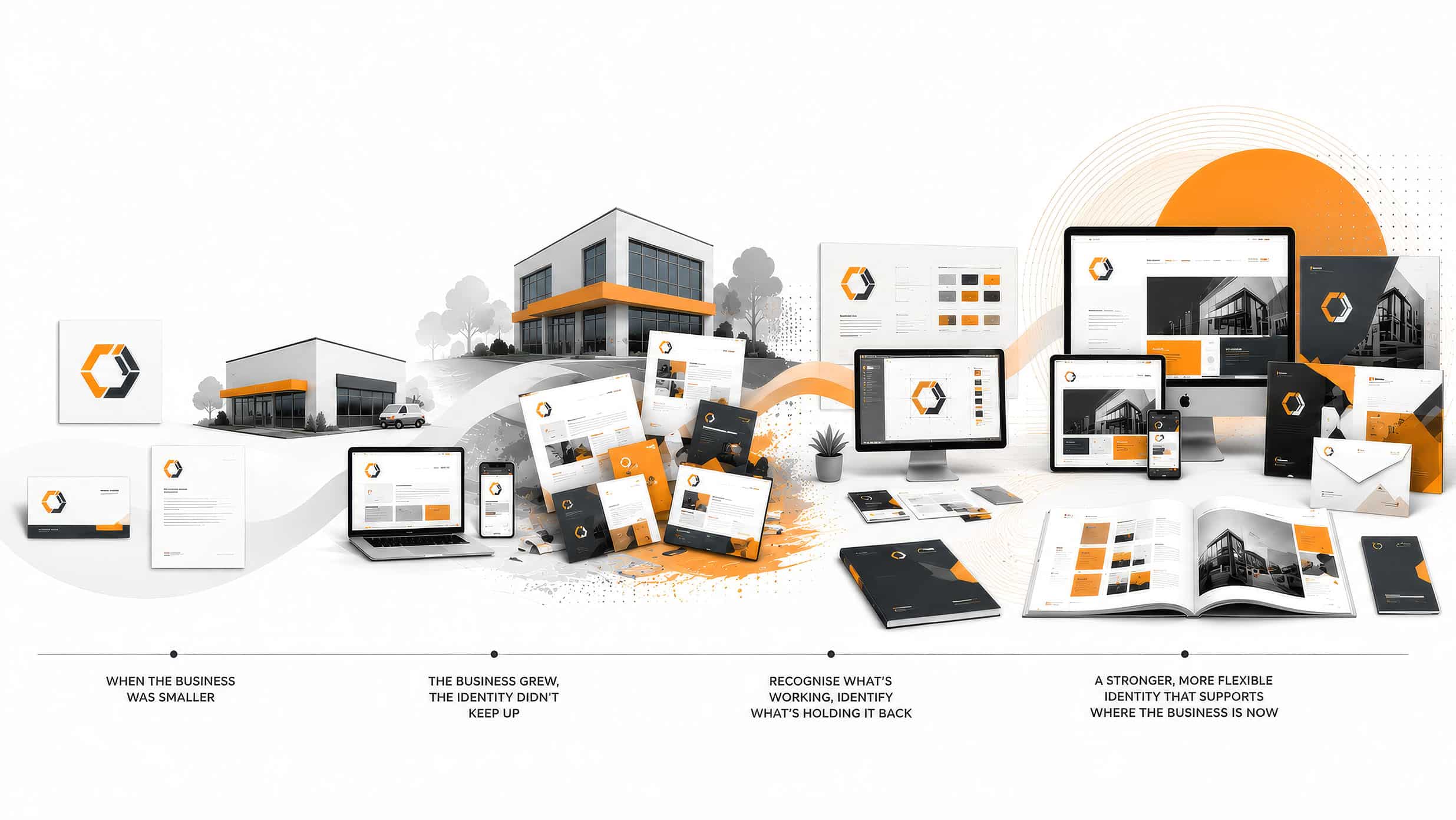
The identity can start making you look smaller than you are
This is where it becomes more than a design issue.
Perhaps the identity was created when you were a much smaller business.
At the time, it did its job.
But now you’re pitching for larger contracts, working with more established clients or competing against businesses with a much stronger presence.
Your capability has moved forward.
The way you present the business hasn’t.
That gap can affect how credible and established you appear before anyone has spoken to you.
Signs your business may have outgrown its brand identity
There are some fairly obvious warning signs:
- your website and marketing material don’t feel connected
- different people produce completely different-looking communications
- you’re constantly inventing new layouts because there isn’t a usable system
- the identity doesn’t work particularly well across digital channels
- your materials make the business look less established than it actually is
- you’ve added services or moved into new markets that the original identity was never designed to support
- you avoid using certain older materials because they no longer represent the business properly
- the logo is doing almost all the work because there isn’t much of an identity around it
If several of those sound familiar, the problem may not be that your logo is wrong.
It may simply be that the identity around it hasn’t kept pace with the business.
You don’t automatically need a rebrand
This is where I’d be careful.
There is a temptation to assume that if the identity feels dated or inconsistent, everything needs to be replaced.
It doesn’t.
If your logo is already recognised and still represents the business well, removing it for the sake of something new may be unnecessary.
Sometimes the stronger answer is to keep what’s working and develop what isn’t.
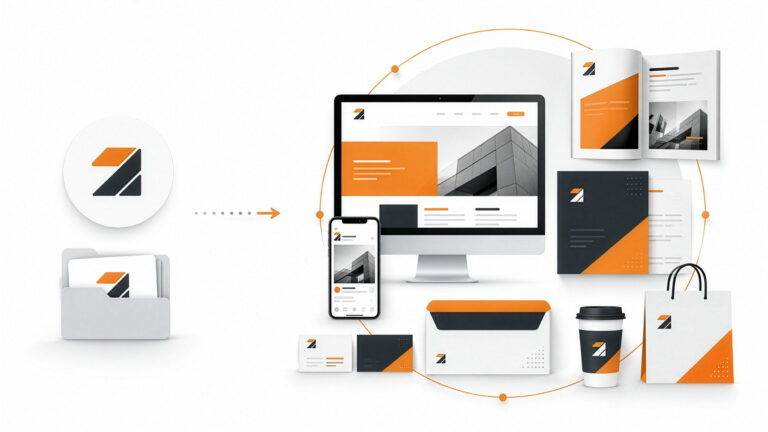
That might mean refining the logo so it works better across different applications, introducing a stronger typography and colour system, establishing an image style, creating supporting graphic elements and showing how everything should work together.
You’re not starting again.
You’re developing the existing identity into a system that can support the business you’ve become.
If you’re unclear about where a logo ends and the wider identity begins, I’ve explained that in… A logo isn’t a brand identity. So what are you actually paying for?
Developing an existing identity can be more valuable than replacing it
We’ve done exactly this with businesses where throwing away what already existed would have made little sense.
For example, The House Interiors already had an identity.
Under new ownership, the challenge was to develop and extend it to properly represent Senait’s vision for the business across the new website and subsequent marketing materials.
The objective wasn’t:
Let’s invent a completely different brand.
It was:
Let’s make the existing identity work properly for the business it now represents.
See The House Interiors case study →
Your brand identity should make future communication easier
This is one of the simplest tests.
A developed identity gives everyone involved in communicating the business a framework to work from.
It shouldn’t mean every brochure, webpage or social post looks identical.
But it should mean you aren’t starting with a blank sheet of paper every time.
There is enough consistency for people to recognise the business and enough flexibility for the identity to work across different situations.
That’s when an identity becomes useful rather than simply decorative.
Has the business moved on but the identity hasn’t?
If the business you’ve become is stronger than the way you’re presenting it, you don’t necessarily need to start again.
You may need to identify what’s still valuable, what has stopped working and how the existing identity can be developed into something more consistent, credible and usable.